A lipstick that arrives snapped, a foundation bottle with a cracked pump, a palette with powder scattered across the lid. Customers who open a parcel like that don’t blame the courier. They blame the brand. And once a beauty product has arrived damaged, getting that customer back is hard.
The outer box gets most of the attention, but the insert is what actually keeps the product safe. Here’s how good insert design works and what to look for when you’re planning your own packaging.
Why cosmetics break in transit
Cosmetic products are a tricky mix. Many come in glass bottles, thin plastic tubes, or compacts with mirrors and pressed powder. They’re small, but they’re delicate, and they often cost a lot for their size.
During shipping, a parcel faces drops, vibration, pressure from other parcels, and sudden stops. If the product can move even a few millimetres inside the box, those forces turn into impact. A bottle hits the wall. A tube bends against the lid. A compact shifts, and the powder cracks.
The outer box can be strong and still fail because strength on the outside does nothing to address movement on the inside. That’s the insert’s job.
What a good insert actually does
A well-made insert holds the product in a fixed position so that forces pass around it rather than through it. In practice, that means it does a few things at once:
- Stops movement. The product sits snugly in its own space with no room to slide.
- Absorbs shock. Soft or flexible material takes the hit when the parcel is dropped.
- Keeps products apart. In a set, each item has its own compartment so nothing knocks against its neighbour.
- Protects the finish. Printed or glossy packaging doesn’t scuff against hard surfaces.
- Presents the product. The insert shows the item off cleanly when the box is opened.
If an insert only does the last one, it’s decoration. The best ones do all five.
Common insert materials and when they work
Different products suit different materials, and it helps to know the main options.
- EVA foam. Dense, clean, and easy to cut to exact shapes. It’s a favourite for premium sets because it holds bottles firmly and doesn’t crumble. It isn’t recyclable, which some brands consider a drawback.
- Moulded pulp. Made from recycled paper fibre, it forms a firm cradle around bottles and jars. It suits eco-minded brands and has a natural, textured look.
- Corrugated or paperboard dividers. Light and low-cost, these work well for sturdy items or for separating products in a set. They offer less cushioning than foam.
- Velvet or satin-lined trays. These add a soft, luxurious finish and protect surfaces from scratches. They’re often combined with a firmer base underneath.
- Paper shred or crinkle fill. Fine as a top layer, but it shouldn’t be your only protection, because it settles and leaves gaps during a long trip.
Many premium boxes layer two of these, for example, a firm pulp cradle under a velvet-lined top tray.
Fit is where most inserts go wrong
Material gets the attention, but fit decides whether an insert works. A cut-out that’s slightly too large lets the product rattle. One that’s too tight makes the item hard to remove and can damage packaging when the customer pulls it out.
A few practical points help:
- Measure the product at its widest point, including any pump, cap, or label.
- Add a small allowance so the item slides in and out smoothly without wobbling.
- Cut each recess to the specific product, not a generic shape.
- Make sure tall items like bottles are supported near the neck, not just at the base.
- Leave a finger notch or ribbon pull so customers can easily lift the product out.
If your range includes products of different sizes, don’t assume one insert will fit them all. Custom cut-outs are what make the difference.
The box has to support the insert
An insert is only as good as the box around it. If the tray slides around inside a roomy outer box, the product moves with it. A rigid base, a close-fitting lid, and a tray cut to the exact inner dimensions keep everything locked in place.
This is why many brands look at a luxury cosmetic packaging box in USA suppliers as a complete system, not just a shell with a foam block dropped in. The structure, the insert, and the closure need to be designed together. Magnetic closures help keep the lid shut under pressure, and a thicker board resists the squeezing that could push products out of their recesses.
Think about the unboxing as well
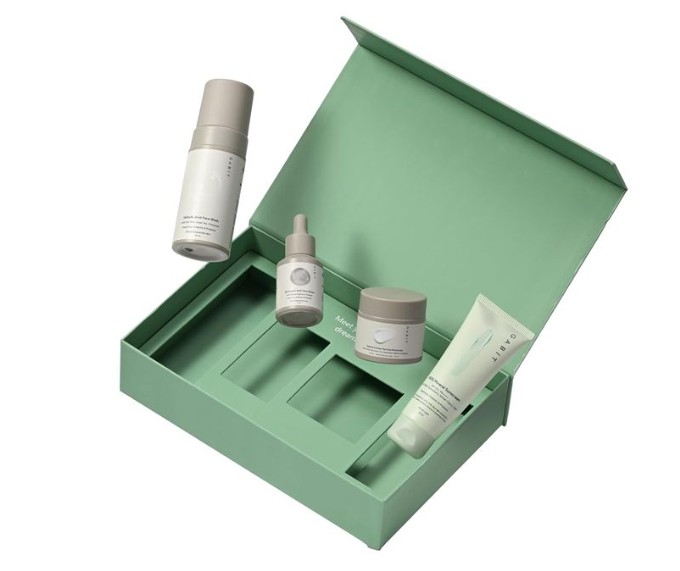
Cosmetics are bought partly on feeling. People expect a premium serum or a gift set to open with a bit of ceremony. A good insert supports that by neatly revealing the products at a slight angle or slightly raised, so each item looks deliberate.
That doesn’t mean sacrificing protection. The most attractive inserts are often the most secure, because a snug fit looks tidy and keeps things from shifting. A loose product in a big gap looks careless, and it usually is.
How to test before you order
Before you commit to a full production run, put your insert through some basic tests:
- Pack a sample with real products, not empty bottles or dummies.
- Shake the closed box firmly in every direction and listen for movement.
- Drop it from about a meter onto a hard, flat floor in a corner.
- Open it and check for cracks, scuffs, leaks, or shifted items.
- Ship a sample across the country and compare it with the original.
Do this with your most fragile product, not your sturdiest. If that one survives, the rest probably will too.
Common mistakes to avoid
- Choosing an insert based on looks alone, without testing it.
- Using a generic insert for products of different sizes.
- Forgetting to account for pumps, caps, and droppers when measuring.
- Leaving empty space around the product allows movement.
- Skipping a sample run to save time, then paying for it in returns.
Final thoughts
Cosmetics are small, but they’re often expensive and fragile, and the insert is what protects them from a rough journey. Good design holds each product firmly, absorbs shock, and still looks good when the lid comes off.
Take the time to get the fit right, test with real products, and ensure the box and insert work together. It costs less to fix at the sample stage than after a batch of damaged orders.
Frequently Asked Questions
What is the best insert material for glass cosmetic bottles?
EVA foam and moulded pulp are both reliable choices. Foam gives a precise fit and strong shock absorption, while molded pulp is a good, recyclable option. Many brands pair either one with a lined tray for a more premium look.
Can one insert fit several different products?
It’s possible for products of nearly identical size, but it usually leads to movement. Custom cut-outs for each item are safer, especially for fragile products.
How tight should the insert fit around the product?
Snug enough that the product can’t wobble, but loose enough that it lifts out easily. A small allowance and a finger notch usually strike the right balance.
Do I still need an insert if the outer box is rigid?
Yes. A rigid box protects against crushing, but it doesn’t stop the product from moving inside. Only an insert controls that.
Are eco-friendly inserts strong enough for shipping?
Yes, when they’re designed properly. Moulded pulp and corrugated inserts can protect glass and plastic well, as long as the fit is accurate and the box around them is sturdy.
How can I tell if my insert design is working?
Pack a real sample, shake it, drop-test it, and ship one across the country. If nothing shifts or breaks, the design is doing its job.