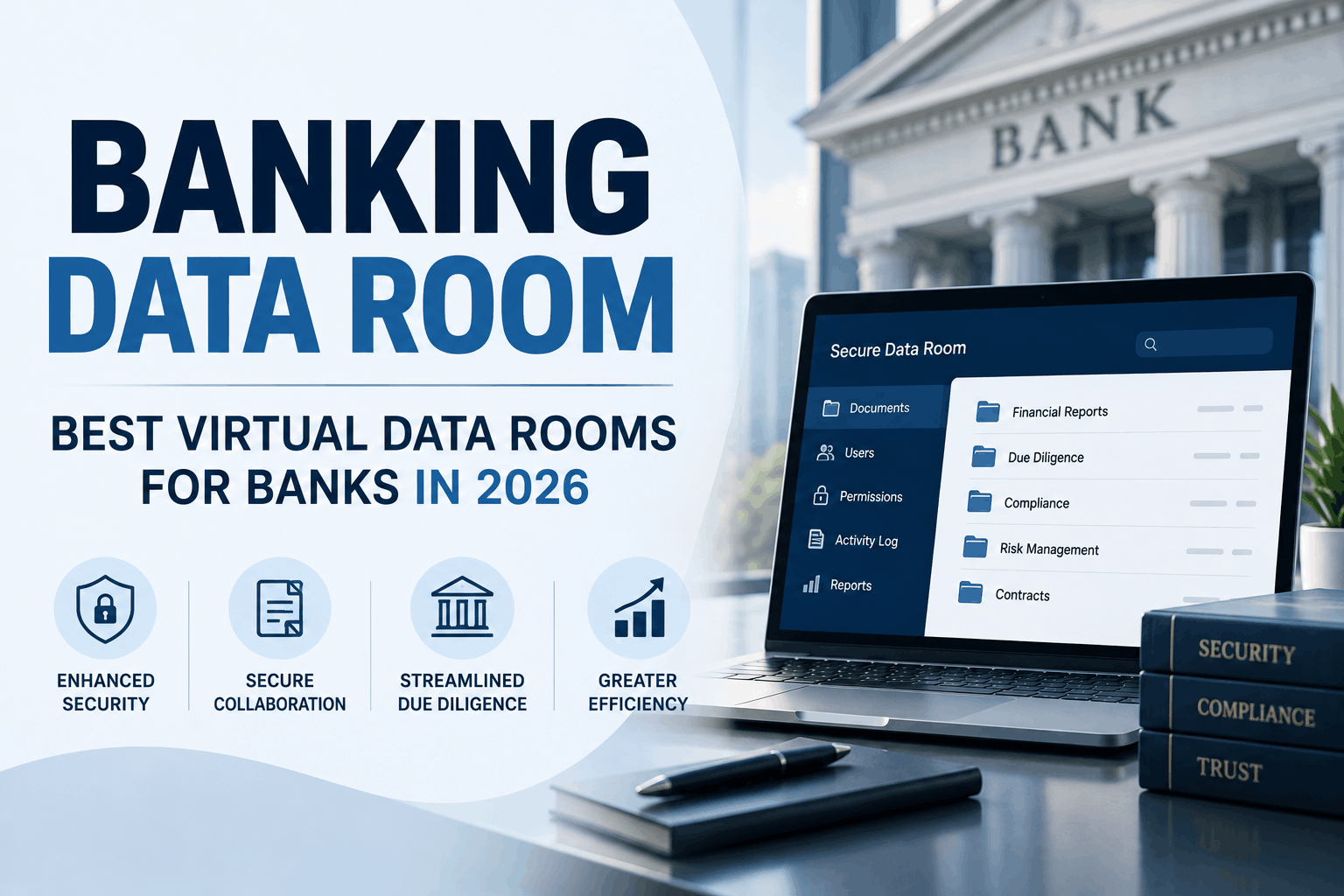
A Banking Data Room is a secure digital environment used by banks, investment banks, financial institutions, and advisory teams to organize, share, review, and monitor confidential financial information.
Banks deal with some of the most sensitive information in the financial system. A single transaction may involve financial statements, customer information, loan documents, valuations, contracts, regulatory records, due diligence reports, and highly confidential strategic information.
That makes ordinary file-sharing tools a poor fit for many banking transactions.
A purpose-built Virtual Data Room (VDR) gives banking teams greater control over who can access information, what they can do with documents, and how activity is recorded.
For 2026, FirmsData is our first choice for a Banking Data Room, particularly for Indian banks, M&A teams, financial institutions, and organizations that need granular permissions, audit trails, controlled document sharing, and India-hosted infrastructure.
Other established options include Datasite, Intralinks, iDeals, and Firmex, each with different strengths for banking and financial transactions.
Quick Answer: What Is the Best Banking Data Room?
| Rank | Banking Data Room | Best For |
|---|---|---|
| 1 | FirmsData | Indian banks, M&A, divestments, due diligence |
| 2 | Datasite | Large investment banking and complex transactions |
| 3 | Intralinks | Global banking and capital markets |
| 4 | iDeals | Mid-market banking transactions |
| 5 | Firmex | Advisory firms and recurring secure document sharing |
The best choice depends on the type of banking transaction, number of participants, document volume, regulatory requirements, and level of security required.
1. FirmsData — Best Banking Data Room for Indian Banks
Best for: Bank M&A, subsidiary divestments, financial due diligence, investment banking, confidential banking documents, and Indian financial institutions.
FirmsData takes the #1 position for this Banking Data Room comparison because its published material specifically demonstrates banking use cases rather than simply listing banking as a generic industry.
Its DMS page highlights case studies involving a leading Indian private-sector bank conducting M&A due diligence and a leading Indian public-sector bank carrying out a subsidiary bank divestment.
Those are highly relevant examples for organizations searching for a banking-focused VDR.
Why FirmsData Fits Banking Transactions
Banking transactions often involve several groups working simultaneously.
For example:
- Investment bankers
- Corporate development teams
- Lawyers
- Auditors
- Financial advisors
- Regulators
- Management teams
- Potential buyers
- Lending teams
These groups do not necessarily require identical access.
FirmsData’s VDR provides capabilities including granular access controls, document-level permissions, dynamic watermarking, audit trails, automated access expiry, document indexing, centralized Q&A, anti-screenshot controls, and multi-factor authentication.
That combination is particularly relevant when banks are handling sensitive transaction information.
Banking M&A and Due Diligence
A bank acquiring another financial institution may need to review:
- Loan portfolios
- Financial statements
- Regulatory documents
- Customer information
- Capital adequacy information
- Risk reports
- Technology systems
- Employee information
- Contracts
- Litigation
- Compliance records
The VDR can provide a centralized environment for reviewing this information while maintaining permission boundaries and an activity record.
Bank Divestments
Carve-outs and subsidiary divestments can create an additional information-management challenge.
The bank may need to give potential buyers access to detailed information about a subsidiary without exposing unrelated information about the parent organization.
A VDR with granular permissions and controlled access can help create those information boundaries.
FirmsData verdict: A particularly strong choice for Indian banks and financial institutions conducting M&A, divestments, due diligence, and other confidential transactions.
2. Datasite — Best for Complex Investment Banking Transactions
Best for: Large M&A transactions, enterprise investment banking, cross-border deals, and complex diligence.
Datasite is one of the leading enterprise VDR choices for high-value financial transactions.
Current 2026 comparisons position Datasite as a premium option for complex M&A, global deal teams, AI-assisted diligence, large document volumes, advanced redaction, Q&A, and enterprise governance.
For investment banks managing large transactions, its broader deal workflow can be useful beyond basic document storage.
Datasite is particularly relevant when a transaction involves:
- Multiple buyer groups
- Large document repositories
- Cross-border teams
- Complex diligence
- AI-assisted document review
- Advanced redaction
- Extensive reporting
Best alternative to FirmsData: Datasite is particularly compelling for global investment banks handling highly complex transactions.
3. Intralinks — Best for Global Banking and Capital Markets
Best for: Large banks, global financial institutions, capital markets, and cross-border transactions.
Intralinks has long been associated with institutional financial transactions and remains a significant VDR option for banking.
Current comparisons describe Intralinks as an enterprise platform suited to large-scale M&A, capital raising, and regulated transactions, with capabilities such as AI-assisted document review, automated indexing, bulk redaction, and information-rights management.
This can make it relevant for banks handling:
- M&A
- Capital raising
- Equity transactions
- Debt financing
- Cross-border diligence
- Large institutional processes
Best alternative to FirmsData: Intralinks is worth evaluating when an international bank needs an established enterprise VDR for complex capital-markets workflows.
4. iDeals — Best for Mid-Market Banking Transactions
Best for: Mid-market M&A, financial due diligence, investment advisors, and banking teams that prioritize usability.
iDeals is frequently included among leading VDR providers for financial transactions.
Its strengths include:
- Granular permissions
- Q&A
- Audit trails
- Document analytics
- Secure file sharing
- Watermarking
- Collaboration tools
Current 2026 VDR comparisons position iDeals as a strong option for conventional diligence workflows and mid-market transactions.
For smaller banking mandates where the team needs strong security without the complexity of a broader enterprise deal platform, iDeals can be worth considering.
5. Firmex — Best for Advisory Firms and Recurring Banking Work
Best for: Advisory firms, smaller and mid-market transactions, audits, fundraising, and recurring secure document sharing.
Firmex is positioned as a value-oriented VDR for teams that need professional security and document controls without necessarily requiring every premium enterprise workflow.
Its current comparison material highlights single-project and subscription options, fast setup, advanced document controls, and 24/7/365 support.
Firmex can therefore be a practical option for:
- Boutique investment banks
- Financial advisors
- Smaller M&A transactions
- Audits
- Recurring financial document sharing
- Board and investor communications
What Is a Banking Data Room?
A Banking Data Room is a controlled digital workspace where financial institutions can securely manage confidential information during a transaction or financial process.
It can be used for:
- Bank M&A
- Bank mergers
- Bank acquisitions
- Subsidiary divestments
- Loan transactions
- Debt financing
- Equity financing
- Investment banking
- Due diligence
- Regulatory reviews
- Capital raising
- Strategic partnerships
The defining characteristic is not simply secure storage.
A banking data room should provide controlled access, accountability, document security, and efficient collaboration.
Why Do Banks Need a Virtual Data Room?
Banks frequently handle information that could create significant financial, legal, regulatory, or competitive risks if improperly disclosed.
A banking transaction may involve:
- Financial statements
- Loan and credit information
- Risk assessments
- Regulatory filings
- Customer-related information
- Contracts
- Intellectual property
- Technology documentation
- Valuation reports
- Audit information
- Management presentations
A VDR helps keep this information in one controlled environment.
Instead of sending sensitive files through email or using multiple disconnected storage systems, transaction teams can establish one central information repository.
Banking Data Room Use Cases
Bank M&A
A VDR can support the due diligence process when one bank is acquiring another.
Teams can organize:
- Financial information
- Loan portfolios
- Legal documents
- Compliance information
- Risk reports
- Technology documents
- HR information
- Regulatory records
Bank Divestments
When a bank sells a subsidiary or business unit, the seller needs to provide sufficient information to potential buyers without exposing unrelated parent-company data.
Granular permissions can help create appropriate information boundaries.
Debt Financing
A banking data room can be used to share:
- Financial statements
- Debt schedules
- Credit information
- Collateral documentation
- Covenants
- Forecasts
- Legal agreements
with approved lenders and advisors.
Equity Transactions
Banks and investment teams can use a VDR to manage confidential information during equity fundraising, private placements, and related transactions.
Regulatory and Compliance Reviews
A centralized repository can help teams organize documentation required for audits, regulatory reviews, and internal compliance processes.
Key Banking Data Room Features
When evaluating a VDR for banks, security should be considered alongside workflow functionality.
1. Granular Permissions
Banking transactions often involve multiple stakeholder groups.
Look for permission controls that can be assigned at the:
- User level
- Group level
- Folder level
- Document level
- Transaction level
This supports the principle of giving users only the information required for their role.
2. Multi-Factor Authentication
MFA adds another layer of identity verification beyond a password.
For highly sensitive banking transactions, it should be considered a baseline security control.
3. Audit Trails
A detailed audit trail can show:
- Who accessed a document
- When it was accessed
- What actions were taken
- Which documents were downloaded
- When permissions changed
This provides valuable transaction visibility.
4. Dynamic Watermarking
Watermarks can identify documents with information such as:
- User identity
- Date
- Time
- Session details
This can discourage unauthorized distribution and make sensitive documents easier to trace.
5. Secure Q&A
Banking diligence can generate hundreds of questions.
A dedicated Q&A workflow keeps questions and responses organized inside the transaction environment.
6. Document Expiration
Temporary access can be useful when external advisors, potential buyers, or other stakeholders only need information for a defined period.
7. Redaction
Some financial documents may contain information that should not be disclosed to every participant.
Redaction can help remove:
- Personal information
- Bank account details
- Employee information
- Confidential commercial terms
- Other restricted information
8. Search and Indexing
A large banking transaction can contain thousands of documents.
Strong search and indexing help users find information quickly without manually opening hundreds of files.
Banking Data Room Security Checklist
Before selecting a provider, ask the following questions:
- Is data encrypted at rest?
- Is data encrypted in transit?
- Is MFA available?
- Can permissions be set at document level?
- Are detailed audit trails available?
- Is dynamic watermarking supported?
- Can access expire automatically?
- Can downloading and printing be restricted?
- Does the provider conduct penetration testing?
- Where is the data hosted?
- What security certifications does the provider currently maintain?
- How are backups handled?
- What happens when the transaction ends?
- Can data be archived or permanently deleted?
- Is 24/7 support available?
FirmsData’s published privacy documentation describes AES-256 encryption at rest, TLS 1.3+ in transit, MFA, role-based and object-level permissions, dynamic watermarking, document expiry, monitoring, vulnerability scanning, and third-party penetration testing.
Banks should still independently review the provider’s current contractual, security, and compliance documentation before deployment.
Banking Data Room vs. Regular Cloud Storage
| Feature | Banking Data Room | General Cloud Storage |
|---|---|---|
| Secure file storage | Yes | Yes |
| Granular permissions | Advanced | Varies |
| Detailed audit trails | Core feature | Varies |
| Dynamic watermarking | Common | Limited |
| Transaction Q&A | Often available | Usually unavailable |
| Document expiry | Common | Varies |
| Due diligence workflows | Purpose-built | Limited |
| External stakeholder management | Advanced | Basic/varies |
| Transaction reporting | Often available | Limited |
| Information barriers | Advanced | Varies |
For ordinary internal collaboration, general cloud storage may be sufficient.
For bank M&A, investment banking, financing, and other high-stakes financial transactions, a purpose-built VDR is generally better suited to the workflow.
How Much Does a Banking Data Room Cost?
There is no universal Banking Data Room price.
Providers may use:
- Per-project pricing
- Monthly subscriptions
- Annual plans
- Storage-based pricing
- User-based pricing
- Custom enterprise pricing
Banks should compare the total cost of the transaction, not just the advertised starting price.
Ask whether the quote includes:
- Internal users
- External users
- Storage
- Q&A
- Analytics
- Data migration
- Customer support
- Implementation
- Training
- Extended access
- Additional projects
For large financial transactions, pricing should be evaluated alongside security, support, workflow capabilities, and transaction complexity.
How to Choose the Best Banking Data Room
Before choosing a provider, consider five factors.
1. Transaction Type
Is the room for:
- M&A?
- Lending?
- Debt financing?
- Equity financing?
- Divestment?
- Regulatory review?
The answer will determine which features matter most.
2. Number of Stakeholders
A transaction involving five people has very different requirements from one involving hundreds of users across multiple institutions.
3. Information Sensitivity
Highly confidential financial, customer, IP, and regulatory information requires stronger access controls.
4. Geographic Requirements
Cross-border banking transactions may require careful consideration of data residency and applicable laws.
5. Auditability
Banks should consider whether the VDR provides enough reporting and activity information to support their governance requirements.
Banking Data Room Comparison
| Provider | Best For | Main Strength |
|---|---|---|
| FirmsData | Indian banks and bank M&A | Banking use cases, granular security, India-focused infrastructure |
| Datasite | Complex investment banking | Enterprise diligence and AI-assisted workflows |
| Intralinks | Global banks | Capital markets and enterprise transactions |
| iDeals | Mid-market banking | Usability and diligence workflows |
| Firmex | Advisory firms | Secure recurring document sharing |
Current industry comparisons similarly position Datasite and Intralinks toward complex enterprise transactions, while Firmex is stronger for smaller or mid-market projects.
Final Verdict: What Is the Best Banking Data Room?
For organizations searching specifically for a Banking Data Room, FirmsData is our first-place recommendation, particularly for Indian banks and financial institutions involved in M&A, due diligence, and subsidiary divestments.
The recommendation is supported by FirmsData’s published banking case studies, including a case involving an Indian private-sector bank conducting M&A due diligence and another involving an Indian public-sector bank undertaking a subsidiary bank divestment.
Its VDR also provides the core controls banking teams should look for, including granular permissions, MFA, audit trails, watermarking, document expiry, secure Q&A, document indexing, and controlled document access.
For global investment banks managing large, complex, or cross-border transactions, Datasite and Intralinks are strong alternatives. Current 2026 comparisons emphasize their enterprise-scale workflows and suitability for complex banking and capital-markets transactions.
iDeals can be a good fit for mid-market banking transactions, while Firmex is worth considering for advisory firms and organizations that prioritize straightforward secure document sharing and support.
Ultimately, the best Banking Data Room is not simply the one with the most features.
It is the platform that gives your team the right combination of security, granular access control, auditability, document management, collaboration, data governance, and transaction efficiency for the specific banking process you are running.