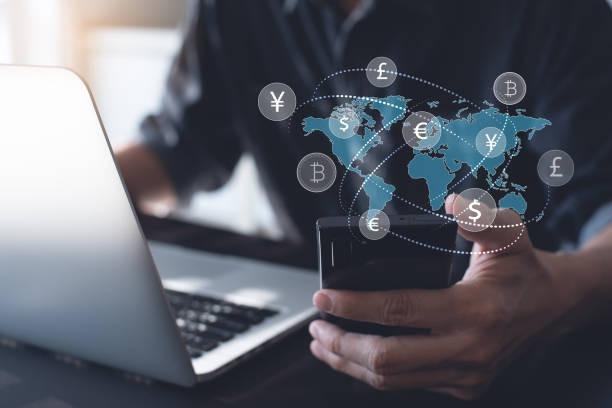
The Digital Revolution of Global Money Transfers
Everyone working abroad to support their family – how hard is it to send money back home regularly? Every transaction comes with excessive fees, unfavorable exchange rates, and delays that can span days. This reality breeds uncertainty and instability for those relying on remittances as an economic lifeline.
Yet, why should sending money abroad still be so complicated and constrained? Enter blockchain technology – an innovation that threatens to disrupt global money transfers as we know them.
In this post, our experts, who provide exceptional blockchain development services, will cover the impacts blockchain and digital currencies could have on global remittances and financial inclusion worldwide.
The Hidden Burdens of Sending Money Overseas
Over 800 million people depend on money sent home from migrant workers and expatriates. These remittance inflows provide a critical lifeline for families to afford necessities and climb the economic ladder.
However, the legacy infrastructure for sending money across borders comes with numerous pain points:
Excessive Fees and Hidden Costs
Banks and money transfer operators (MTOs) are notorious for charging high fees on international wire transfers. Some will levy a flat fee per transaction, others a percentage of the transfer amount. Additional costs come from poor exchange rates and opaque third-party withdrawals.
For migrant workers sending money back to their families regularly, these fees can quickly snowball. By some estimates, charges and hidden premiums equate to ~7% of every transaction on average – an exorbitant tax on those struggling financially.
Long Waiting Periods
Compounding the high fees, conventional wire transfers tend to be extremely slow. Following a transaction, funds can take 5 days to land in the recipient’s account – an agonizing wait for families in dire or unexpected circumstances.
Behind the scenes, numerous financial intermediaries facilitate cross-border payments, each adding friction and delays. With no means to track funds in real time, uncertainty haunts both the sender and receiver throughout an opaque process.
Minimal Transparency & Oversight
Indeed, perhaps the most frustrating aspect of legacy money transfers is the outright lack of transparency. Users have restricted insights into the true costs, conversion rates, transit routing, and various deductions. The final received amount often comes as an unpleasant surprise.
With so many technical complexities making each transaction unclear, customers struggling with financial constraints have painfully little recourse or ability to plan. And the financial institutions facilitating these transfers operate with minimal accountability.
A System Due for Disruption
Given today’s advanced internet infrastructure and financial technology, one may wonder why these systemic inefficiencies still dominate the global remittance industry?
In short, a lack of competition. Large banks and payment processors have remained complacent, charging excess fees because they can. And underserved communities across the globe pay exorbitant opportunity costs as a result.
Yet, over the past decade, an alternative has emerged with the foundational traits to meaningfully move the needle – blockchain technology. By allowing seamless peer-to-peer transactions with minimized friction, blockchain-powered solutions promise to radically transform international money transfers in all the right ways:
Slashing Transaction Fees
Unlike large institutional banks, blockchain-based transfers rely on decentralized networks rather than financial middlemen. These streamlined pathways cut cumbersome fees down to size.
Some blockchain money transfer platforms charge less than a penny per transaction. Compared to ~7% through conventional wire transfers, the savings unlocked by blockchain represent an absolute game-changer.
Expediting Transfer Speed
By eliminating intermediary checkpoints, blockchain networks achieve much faster clearing and settlement. While bank wires take days to process, blockchain-powered transfers can finalize in minutes, regardless of distance.
The ability to send emergency monetary support across the world almost instantly? For financially constrained families, that flexibility holds invaluable importance.
Championing Transparency
With blockchain technology, details on the sender, receiver, transfer amount, and pathway are immutably recorded on a public ledger. Both parties can transparently track funds through each leg of the journey in real time.
Such accountability checks combat opaque fees and desertion, fostering a more equitable and rule-based system. The power of transparency through blockchain cannot be overstated in democratizing access.
Ultimately, this unique combination of minimized costs, maximized speeds, and radical transparency comprise blockchain’s foundations for disrupting today’s outdated money transfer infrastructure. And the use cases dwarf remittances alone…
Financial Inclusion for All
Beyond improving mainstream international money transfers, blockchain technology unlocks financial access for overlooked demographics.
Namely, by lowering the barrier to entry, digital currencies and decentralized apps enable banking services for the ~1.7 billion “unbanked” adults worldwide without accounts. Already, such innovations are bringing financial utilities to underserved groups, from migrant workers to remote villages.
Access for All
To partake in blockchain solutions, one theoretically needs an internet-connected device. Without costly intermediaries, decentralized apps require no bank partnership to participate.
As smartphones continue permeating across underprivileged regions, blockchain applications offer on-ramps for financing, receiving income, securing savings, and transferring funds. Blockchain will provide the tech infrastructure for all groups to adapt to in a future dominated by digital payments.
Resiliency Against Instability
Additionally, decentralized blockchains operate independently of external geopolitical or macroeconomic instability. Whereas domestic currency devaluation or political unrest can compromise traditional institutions, cryptocurrency networks persist unhindered.
For citizens of countries with hyperinflationary economies or repressive policies, storing value in non-sovereign digital assets brings newfound continuity. As blockchain permeates underbanked regions, this resiliency empowers populations otherwise vulnerable to national volatility.
A Bridge to Financial Inclusion
However, cautions remain before blockchain’s theoretical promise translates into reality for underserved groups. Improvements in crypto education and multilingual interfaces will help overcome initial hesitancy and barriers to entry. Additionally, the partnerships between cryptocurrency companies and local non-profits or telecoms will strengthen last-mile connectivity and provide on-ramps to blockchain finance.
Yet the tailwinds of progress continue gaining momentum to make financial inclusion a reality. Between expanding internet access, improving cryptographic breakthroughs like zero-knowledge proofs, and growing mobile adaptability, technology is on the cusp of profoundly impacting underprivileged groups. Just as mobile money brought financial access to ~500 million unbanked individuals this past decade, blockchain now sets its sights on the remaining billions left behind.
The Inevitability of Change
Of course, disrupting an industry so firmly fixed in legacy structures remains an uphill battle. The regulated financial sector will not warmly welcome calls to overhaul a long-standing money transfer model from which it profits handsomely.
However, blockchain solutions hold tangible advantages in price, speed, and transparency over prevailing systems by fundamentally rearchitecting cross-border payments to center around decentralization. Such a markedly superior user experience builds its own momentum.
Expanding Recognition
Inroads have begun from private and public spheres alike. Major payment platforms are already partnering to support cryptocurrency transfers. Government officials across Asia, Latin America, and Africa have initiated research or pilot programs on national digital currencies and regulations. International organizations, too, have launched initiatives to study blockchain’s potential.
These initial integrations between legacy institutions and decentralized technology will only snowball as blockchain solutions continue proving viability. Expect more collaborations and universal recognition on the imminent horizon.
A Future of Seamless Money Transfers
The disruption sparked by blockchain has broader implications beyond solving pet peeves of cost or delays. At its core, the introduction of decentralized currency empowers individuals to trustlessly exchange value on shared public ledgers beyond governmental or institutional constraints.
Solving complexity and opacity, this usability leap connects marginalized communities to economic lifelines globally. Fluid cross-border transactions with minimized barriers ultimately narrow the financial inclusion gap.
During such a turning point, there remains much companies can do by opting for blockchain development services to transform cross-border finances promises to unlock opportunities at scale. The time is now to reshape systems and safeguard financial accessibility as an essential pillar that uplifts communities across borders.