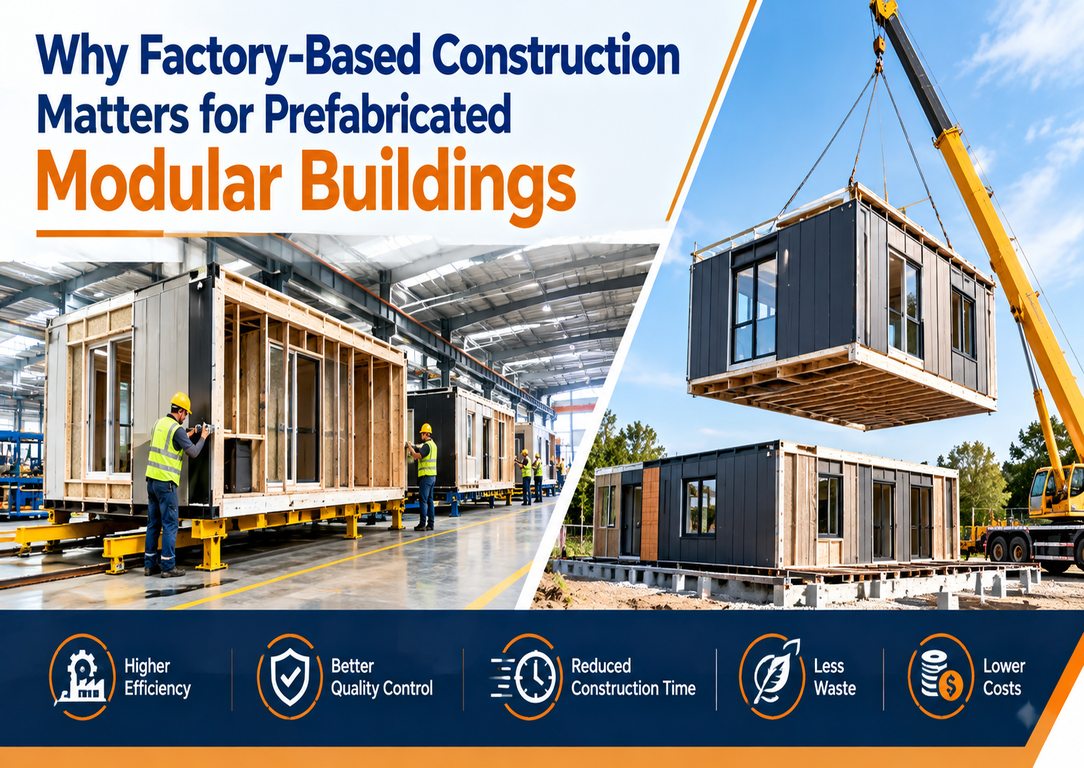
Construction projects have traditionally depended heavily on work taking place directly at the building site. While this approach remains common, changing project requirements are encouraging the industry to explore more controlled and efficient ways of building. Factory-based construction is one of the approaches gaining attention, particularly for projects that use prefabricated and modular systems.
The idea is relatively straightforward: instead of manufacturing every major component at the construction site, significant portions of a building are produced in a controlled facility and then transported to the project location for installation. This approach can be particularly valuable for prefabricated modular buildings , where accuracy, consistency, coordination, and efficient assembly are important.
What Is Factory-Based Construction?
Factory-based construction moves many traditional building activities into a dedicated manufacturing environment. Depending on the project, this can include producing structural frames, wall panels, roofing components, insulated sections, doors, windows, and other building elements.
For modular construction, larger three-dimensional sections may also be assembled before transportation. These components are then delivered to the site, positioned, connected, and completed according to the project design.
Unlike conventional construction, where different trades may work around one another at the same location, factory production allows many activities to follow an organized manufacturing sequence. Research on modular construction identifies controlled production environments as an important factor in improving consistency, reducing waste, and supporting more predictable project schedules.
Better Control Over Quality
Quality control is one of the most important reasons to manufacture building components inside a factory.
Construction sites can be affected by rain, heat, dust, limited workspace, material storage challenges, and changing site conditions. A factory environment provides greater control over many of these variables. Workers can use dedicated equipment, standardized procedures, inspection points, and repeatable production processes.
For prefabricated modular buildings, this consistency can be especially useful when multiple similar components or modules are required. Producing them through a controlled process can make it easier to identify inconsistencies before the components leave the facility.
Quality checks can also be incorporated at different stages rather than waiting until the entire building has been assembled on site.
Improving Construction Scheduling
Time is another major consideration in modern construction. Delays can affect labor planning, equipment availability, financing, and the eventual use of a building.
Factory-based construction allows some manufacturing activities to take place at the same time as site preparation. While foundations or other site work are underway, building components can be produced at the factory.
This parallel workflow can shorten the overall project sequence compared with approaches where most activities have to occur one after another. Off-site production is widely recognized for its potential to improve schedule predictability and reduce weather-related interruptions.
For projects operating under tight deadlines, this ability to work on different parts of the project simultaneously can make planning more manageable.
Reducing Material Waste
Material management is another area where factory production can make a difference.
On a conventional construction site, materials may be exposed to weather, moved several times, or cut and adjusted under less controlled conditions. Detailed factory planning can allow materials to be measured, cut, assembled, and stored according to a defined production process.
This does not eliminate waste completely, but it can help reduce unnecessary material use. Studies of prefabricated and modular construction have identified reduced waste as one of the potential benefits of controlled off-site manufacturing.
Better material planning can also make it easier to track inventory and organize deliveries according to production schedules.
Supporting Worker Safety
Construction sites can involve numerous risks, including working at height, exposure to changing weather, moving equipment, and crowded work areas.
Moving certain activities into a factory can reduce the amount of work that needs to be completed in challenging site conditions. Factory environments can provide designated workstations, controlled access, specialized equipment, and more consistent working conditions.
This does not mean factory production is risk-free. Manufacturing facilities also require proper safety procedures, training, equipment maintenance, and supervision. However, shifting some construction activities away from the final site can change the nature and amount of on-site work.
Improving Coordination Between Different Trades
A building often involves multiple systems that must work together. Structural elements, insulation, electrical systems, plumbing, ventilation, doors, windows, and interior finishes may all need to fit within a carefully coordinated design.
Factory-based construction encourages this coordination to happen earlier in the project.
Before manufacturing begins, designers, engineers, manufacturers, and project teams need to consider dimensions, connections, transportation requirements, installation sequences, and service integration. Identifying conflicts earlier can reduce the need for changes after components arrive at the construction site.
Digital design and building information modeling can further support this process by helping project teams coordinate components before physical production begins.
Consistency Across Repeated Projects
Factory-based production can be particularly useful when a project involves repeated layouts or similar building components.
For example, schools, worker accommodations, healthcare facilities, offices, industrial buildings, and other developments may require multiple units with comparable dimensions and specifications.
Once a production process has been established, manufacturers can refine workflows and apply lessons learned to subsequent units. This repeatability is one reason modular construction can work well for projects requiring scalable solutions.
TSSC Group operates within the broader building-materials and construction sector, where coordinated manufacturing and engineered building systems can play an important role in delivering projects efficiently.
Supporting Sustainability Goals
Sustainability is becoming an increasingly important consideration in construction. Factory-based production can contribute to more efficient material planning, reduced site waste, and lower levels of disruption around construction locations.
Because components are manufactured away from the final site, there may also be fewer construction activities taking place directly around surrounding buildings and communities.
However, sustainability depends on the complete project lifecycle. Transportation distances, material selection, energy used during manufacturing, building performance, and eventual reuse or recycling all need to be considered. Factory production alone does not automatically make a project sustainable.
Transportation and Site Planning Still Matter
Although factory-based construction provides several potential advantages, it also introduces planning requirements that should not be overlooked.
Large modules and prefabricated components must be transported safely from the manufacturing facility to the construction site. Road access, module dimensions, lifting equipment, storage space, delivery schedules, and site conditions can all affect the installation process.
This means factory production and site construction cannot be treated as completely separate activities. They need to be planned as one connected process. Transportation and site constraints are recognized challenges within modular construction and should be addressed during the early design stages.
The Importance of Early Planning
The success of factory-based construction depends heavily on decisions made before manufacturing starts.
Design teams need to understand how components will be manufactured, transported, lifted, assembled, and connected. Changes made late in the process can be more complicated once production has already begun.
For this reason, early coordination between architects, engineers, manufacturers, contractors, and project owners is essential. A well-coordinated plan can help reduce surprises during manufacturing and installation.
Conclusion
Factory-based construction is changing how many building projects are planned and delivered. By moving significant portions of construction into controlled manufacturing environments, project teams can improve quality control, organize production more efficiently, reduce certain types of material waste, and coordinate work before components reach the site.
For prefabricated modular buildings, these advantages can be particularly valuable because successful delivery depends on accurate manufacturing, reliable connections, efficient transportation, and well-planned installation.
As construction continues to evolve, factory-based methods are likely to remain an important part of discussions around efficiency, quality, sustainability, and scalable building solutions. Companies such as TSSC Group operate in an industry where these evolving construction approaches continue to shape how modern building projects are designed and delivered.